
Best 3D printers for beginners
Updated 18 September 2026 · Live prices on every page load from United States marketplaces
Cheap enough that a first-year hobbyist can afford it, with auto-levelling so you are not squaring the bed with a scrap of paper in week one. Nothing here assumes you want to tinker.
- #1
 LongerNew LK10 Plus$378 Bedslinger · 41.0 L · 300°C · Eddy current
 - #2
 R QIDI TECHNOLOGYQIDI Q2C$349 CoreXY · 18.9 L · 370°C · Loadcell Sensor Integrated int
 - #3
 CrealityK2 SE$233 CoreXY · 11.6 L · 300°C · Smart leveling
 - #4
 ELEGOOCentauri 2$329 CoreXY · 16.8 L · 350°C · Four-point auto leveling
 - #5
 CrealityHi$399 Bedslinger · 20.3 L · 300°C · Auto Leveling
 - #6
 CrealitySPARKX i7 Multi-Color$359 Cartesian · 17.6 L · 300°C · Full-auto leveling
 - #7
 FLASHFORGEAdventurer 5M$249 CoreXY · 10.6 L · 280°C · Automatic
 - #8
 CrealityEnder-3 V3 Plus$555 CoreXZ · 29.7 L · 300°C · CR-Touch
 - #9
 LongerLK10$294 Bedslinger · 13.4 L · 300°C · Eddy current
 - #10
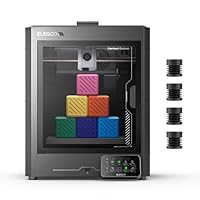 ELEGOOCentauri Carbon$360 CoreXY · 16.8 L · 320°C · Auto-leveling
No listings match your current marketplace selection - tick more sources above.
Matt's take
A first printer isn't a forever printer, and that's fine. The fastest way to decide whether you'll stick with the hobby is a machine that works out of the box with PLA and PETG - you don't need a heated chamber, carbon-fibre hot end, multi-material unit, or 32 mm³/s flow on day one. Don't let a YouTube comparison to the best Bambu talk you out of a sensible £250 entry. What actually matters on a first printer: auto-levelling that works, a bed that heats in under 5 minutes, a filament sensor that catches runouts, and a community big enough that every failure mode has a thread. Speed, build volume, hot-end temperature - upgrade those when you hit their ceiling, not before.
Frequently asked
How much should I spend on my first 3D printer? +
Between £200 and £350 is the honest sweet spot in 2026. Below £200 the quality falls off a cliff; above £350 you are paying for capabilities (heated chamber, CoreXY, multi-material) that a beginner will not use in the first six months.
Resin or filament for a first printer? +
Filament (FDM) unless you specifically want tabletop miniatures and have a well-ventilated space. Resin workflow involves nitrile gloves, IPA washing, a UV cure station and responsible disposal - it is not the casual hobby FDM is.
Is auto-levelling really necessary? +
Yes. Manual bed levelling is the single biggest cause of first-week frustration and abandoned printers. Every printer on this list has automatic mesh levelling. Load-cell or LiDAR is a nice upgrade but bog-standard BLTouch-style probes are fine too.
What can my first printer actually print? +
PLA for almost anything visual, PETG for anything that needs to survive a car interior or outdoor use, and TPU for flexible parts if the extruder is direct-drive. ABS, ASA and nylon all want a heated chamber - save those for printer number two.
Related reading
Ranking is spec-driven. It favours printers that objectively have the capabilities this shortlist targets. Firmware, support quality and long-term reliability aren't on the spec sheet - read the full printer page and owner reports before committing.
